
Event Dependent
Payment Flow
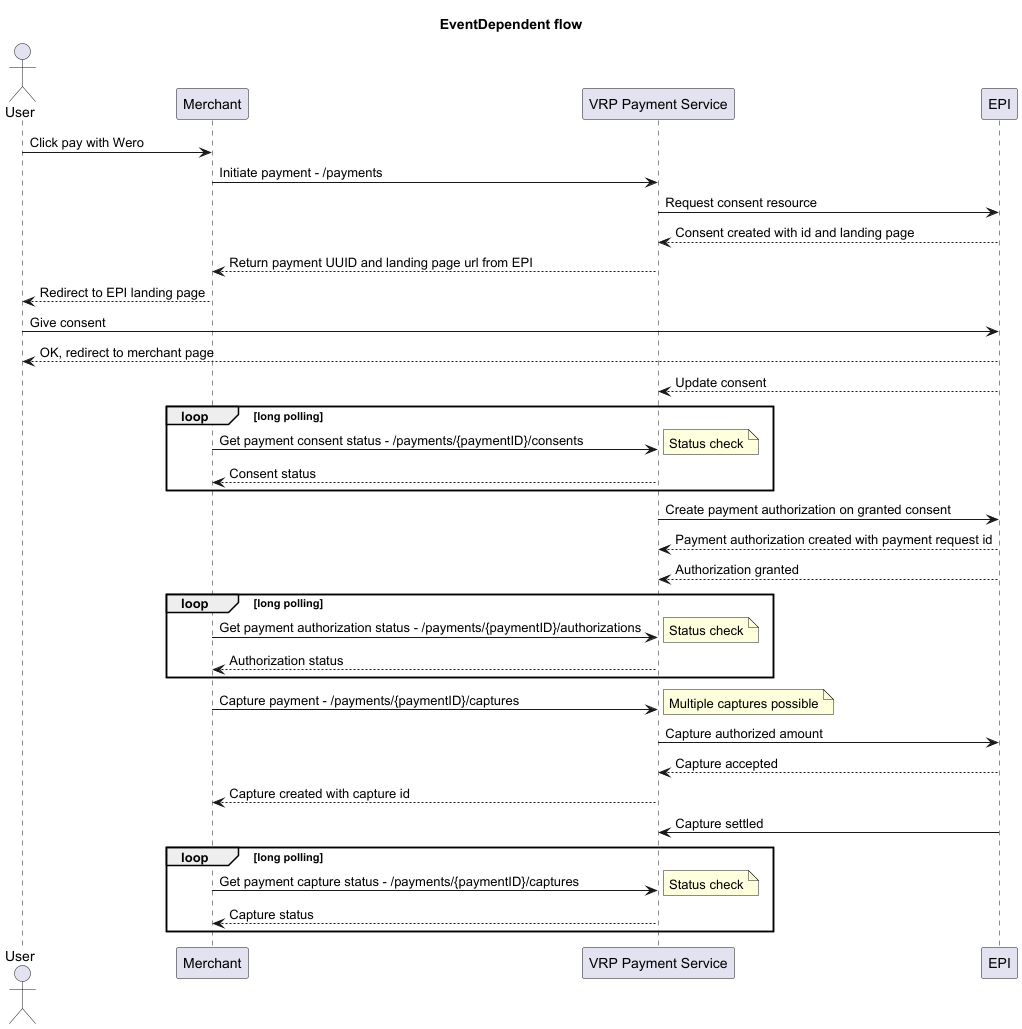
Notice for Merchants with Existing Payment Plan Event Dependent IntegrationAt UAT from 4th of August the IntermediateFrontend and along with it displaying the spinner will disappear. Our returnURL will already be triggered once the consent request reached a final status. From this time on, also new merchants will be boarded without the IntermediateFrontend.
Endpoints
| Action | Endpoint |
|---|---|
| Request Payment | POST /payments |
| Retrieve Consent | GET /consents |
| Retrieve Authorization | GET /authorizations |
| Cancel Authorization | DELETE /authorizations/{authorizationId} |
| Retrieve Capture | GET /captures |
| Capture Payment | POST /captures |
Description
An Event Dependent Payment is a payment that is initiated but not finalized until a predefined business event occurs. Instead of being captured immediately at checkout, the payment remains in a pending state and is only confirmed (captured) when the merchant explicitly triggers the event. It is possible to perform multiple captures.
Fulfillment is conditional, meaning: a payment should only be executed after goods have been shipped, a service has started, or an event has taken place.
Customer authorization is required up front. The actual capture of payment should be delayed until the merchant confirms the event.
Typical use cases/scenarios
- E-Commerce: The payment is only finalized when the physical goods have been shipped.
- Example I: Customer orders a laptop online. The payment remains pending until the merchant's warehouse confirms shipment.
- Example II: Customer orders three books. Merchant delivers two books and captures the amount for both books separately. With the shipping of the third book, the final capture is triggered.
Key characteristics
- Use Case: EVENT_DEPENDENT
- Lifecycle: PENDING → SUCCESSFUL/FAILED
- Authorization: Customer provides authorization upfront, but he is not debited until the merchant triggers the capture.
- Merchant controlMerchant triggers the event , or the payment expires once the time limit for the capture is over-due.
Recommendations
- When using Wero, it is recommended to perform the status check multiple times (or long polling), since — for technical reasons — it can occasionally take more than just a few seconds until a payment capture is successfully completed.
- Merchants should not delete transactions that appear to be stuck in a pending capture status. Instead, if the merchant wishes to discontinue with the payment, such transactions should be cancelled properly.
Merchant benefits
- Risk reduction: Captures occur only when the service/goods is actually delivered.
- Payment lifecycle reflects business events (shipment, service start, event participation)
- Improved customer experience: Customers see payments executed only when relevant conditions are met.
Updated 3 months ago